Dental Implant Recovery, Answered
Healing stages from placement to crown, eating rules, and what pain or movement is normal. Every answer below is written from published clinical guidance and cited to its sources.
Healing timeline
It depends on whether the graft was done before the implant or alongside it. A staged graft placed first typically needs about three to six months to mature before the implant goes in, which adds that time to the front of your treatment. A small graft placed at the same time as the implant often adds little or nothing, since it matures during the same osseointegration window. A sinus lift usually adds the most, often four to nine months.
Usually yes, but only after your surgeon or dentist has adjusted it. A denture or flipper that rests on a healing implant site transmits chewing force straight onto the implant, which is exactly what osseointegration needs protecting from. The appliance is normally hollowed out over the site and softly relined so it bridges the area without touching it. Many surgeons also ask you to leave it out entirely for the first 24 to 48 hours, and to sleep without it.
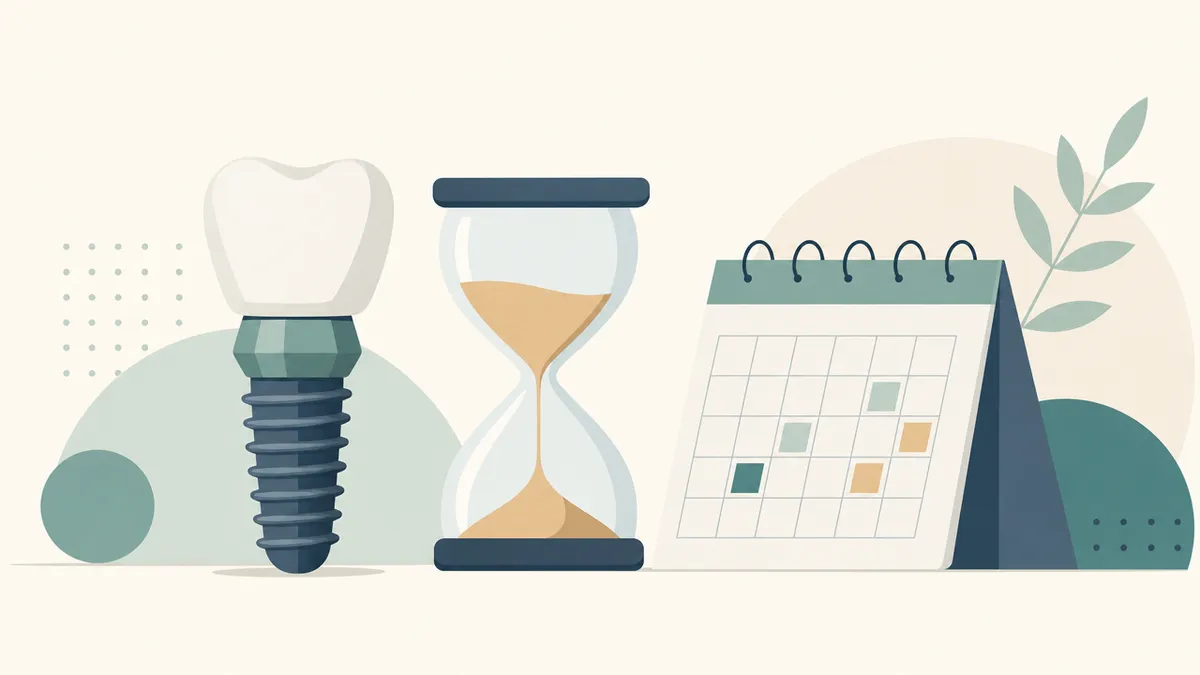
Dental implant healing runs in three stages. Soft tissue heals over the first 1 to 2 weeks, osseointegration (bone fusing to the implant) takes roughly 3 to 6 months and can run as long as 9 months, and then the abutment and final crown are fitted over another few weeks. If you needed a bone graft or sinus lift first, add several more months before the implant is even placed.
There are three standard options. Immediate placement puts the implant into the socket during the same appointment as the extraction. Immediate-delayed or early placement waits a few weeks to about two months for the gum to heal. Delayed placement waits until the bone has healed, commonly three to six months. Cochrane found there is not enough evidence to declare one clearly better, so the choice comes down to your infection status, bone volume and your surgeon's judgement.
A straightforward single implant in healthy bone usually takes about four to seven months from consultation to final crown, most of which is waiting for osseointegration. Add an extraction, a bone graft or a sinus lift and the total commonly runs nine to sixteen months. A minority of well selected cases get a temporary tooth on the day of surgery, but the final crown still waits for integration. Your bone quality and site decide which scenario you are in.
Pain after dental implant surgery usually peaks about 24 hours after the procedure, falls noticeably by 72 hours, and is gone or nearly gone within a week for most people. Studies tracking implant patients found pain highest at the 24 hour mark and clearly lower at 72 hours. Longer or more complex surgery, grafting, and multiple implants all extend it. Pain that increases after day three, or that starts weeks later, is not part of normal healing.
Osseointegration is the process where living jawbone grows directly onto the surface of a titanium implant and locks it in place. It takes roughly three to six months for most people, and Cleveland Clinic gives a range of three to nine months depending on how you heal. Dense lower jaw bone integrates faster than soft upper jaw bone. It happens silently, so feeling fine after two weeks tells you nothing about whether it is complete.
Eating and drinking
Stick to cool or lukewarm liquids and very soft foods for the first 24 hours, then soft foods that need almost no chewing for about the first week to ten days. Chew on the opposite side of your mouth the whole time. No straws, nothing hot, nothing crunchy or sharp, and no alcohol while you are on prescription pain medication. Your surgeon may extend the soft diet if you also had a bone graft.
You chew on the implant once it carries a restoration your dentist has cleared for function, which for most people means after the final crown is fitted, roughly 3 to 6 months after placement. A healing cap or healing abutment is a gum shaper, not a chewing surface. Some patients get an immediate temporary crown on the day of surgery, but those temporaries are usually built out of contact so you still do not chew on them.
Do not drink alcohol at all while you are taking prescription pain medication or antibiotics after implant surgery, and most surgeons prefer you wait until the first week of healing is behind you. There is no strong trial evidence setting an exact number of days for alcohol and dental implants specifically, so the practical rule is the drug interaction rule plus common sense about a fresh surgical wound. Ask your own surgeon for their cutoff.
Getting back to normal
Avoid strenuous exercise for the first two to three days after dental implant surgery. Light walking is fine and even helpful from day one. Most people ease back into moderate exercise around day three to five and return to full training by the end of the first or second week, guided by swelling and comfort. Contact sports and anything that risks a blow to the face need longer and a mouthguard, so ask your surgeon before returning.
The honest answer is that there is no safe day to restart. A 2024 meta-analysis of thirty cohort studies found the risk of early implant failure in smokers was about double that of non-smokers, and other reviews found more marginal bone loss around implants in smokers. Surgeons commonly ask patients to stop for at least one to two weeks before surgery and stay off through the whole osseointegration period, which is months. Ask your surgeon for their specific requirement.
Is this normal?
Yes. Swelling after dental implant surgery is expected, builds over the first 48 to 72 hours, and then steadily falls, usually settling within about a week. Bruising on the cheek, jawline or under the chin is also normal and can appear a day or two later, often turning yellow or green before fading over one to two weeks. What is not normal is swelling that increases again after day three, or swelling with fever, pus or trouble swallowing.
It depends on when it appeared. In the weeks after surgery, a white or gray metal collar showing through the gum is usually the healing cap or cover screw, which is meant to be there and shapes the tissue while the implant integrates. Metal that appears months or years later, especially around a finished crown, usually means the gum has receded, and that needs assessing. Either way, send your dentist a photo and ask.
More questions
The first 48 hours are about protecting the clot and controlling swelling. Bite on gauze as directed, use cold compresses in 20 minute cycles, keep your head elevated, eat soft cool food, and take pain medication on the schedule you were given rather than waiting for pain. Do not rinse, spit, use a straw, smoke or exercise hard. Swelling will peak at the end of this window, and that is expected rather than a problem.
Brush your other teeth gently the day after surgery but keep the brush off the implant site for about the first three days, then start cleaning it gently. Warm salt water rinses from around day three help, and many surgeons prescribe a chlorhexidine rinse for the first week or two. Once healed, an implant needs the same daily brushing and flossing as a natural tooth, because plaque around implants causes peri-implant disease.
No. A dental implant itself should never feel loose or move at any stage, and an implant that moves has not integrated or is failing. That said, most patients who feel movement are actually feeling a loose healing cap, abutment screw or crown, which is a common and usually simple fix. You cannot tell the difference at home. Call your dentist or surgeon the same day, stop chewing on that side, and do not keep testing it.
The single most useful early sign is direction of travel. Normal implant healing improves every day after about day three, so pain or swelling that increases after day three, or returns after settling, is the earliest warning. Add pus, a persistent bad taste or smell, fever, swollen neck glands, or gum that is red and bleeding around the implant. Later on, bleeding when you brush around the implant is the earliest sign of peri-implant disease. Call the same day.
Non-dissolving stitches after implant surgery are usually removed at a follow up visit around one to two weeks after the procedure. Dissolving stitches loosen and fall out on their own over roughly one to two weeks, and MedlinePlus notes it is normal for stitches to loosen and dissolve without being removed. Removal is quick and usually painless. Ask your surgeon which type you have, because if they are dissolving there may be no removal appointment at all.
A healed dental implant should be completely painless, so pain months or years later is always worth investigating rather than waiting out. The usual causes are peri-implantitis, a loose abutment screw, a bite that is overloading the implant, a problem in a neighbouring tooth being felt at the implant, nerve irritation, or food packing under the crown. None of them improve on their own, and the earliest ones are the cheapest to fix.